Agent Platform · 105+ endpoints · Live
Nova ADK
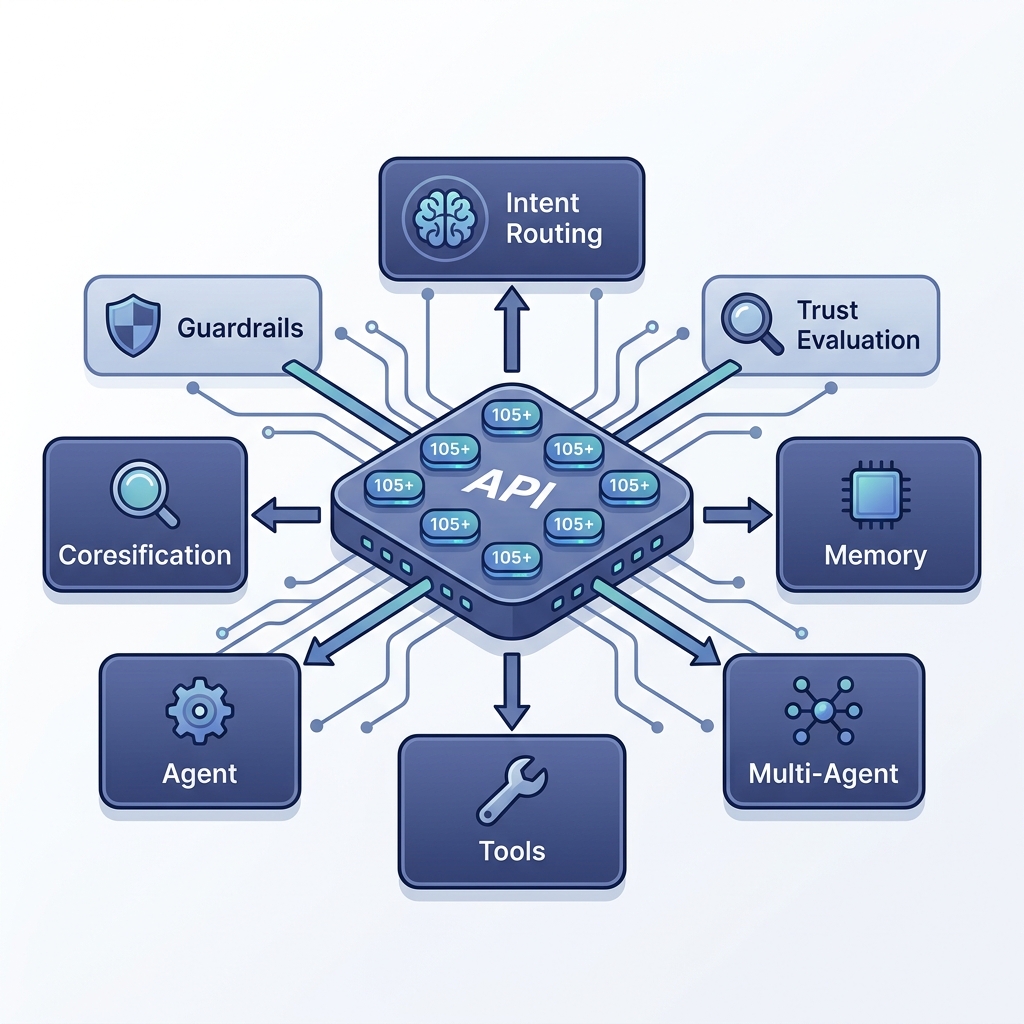
A full-stack platform for building, running and governing AI agents. Over 105 endpoints covering the agent lifecycle, the run pipeline, memory, tools and orchestration, with the API documentation public.
The problem
- Status
- Live, public API
- Surface
- 105+ endpoints
- Modules
- 14 feature areas
- Role
- Sole engineer
Most teams building agents rewrite the same scaffolding every time. Routing a request to the right handler, keeping conversation state, exposing tools safely, deciding what an agent may do unsupervised, and working out afterwards why it said what it said.
Nova ADK is that scaffolding as a platform. An agent is a configuration rather than a codebase, and the parts that are genuinely hard to get right, guardrails, trust evaluation and audit, are built once and shared by every agent on it.
Architecture
Every request passes the same four pipeline stages, so a guardrail added once applies to every agent on the platform.
Decisions worth defending
Trust evaluation runs on output, not on faith
Every response is scored before it leaves the pipeline. An agent that is usually right and cannot tell you when it is wrong is not deployable into anything that matters, so the evaluation stage is part of the run rather than a monitoring afterthought.
Guardrails sit before the model, not after
PII detection happens on the way in. Redacting a response after the fact means the sensitive data already reached the provider, which is the part that actually matters for compliance.
Tools are typed and closed
An agent reaches the outside world only through declared tools with validated arguments. It chooses the operation; it never chooses the endpoint. Letting model output determine a URL hands a language model the ability to make arbitrary requests from inside your network.
Templates because agents repeat
A marketplace of prebuilt agents exists because most real deployments are variations on a handful of shapes. Building the base once and configuring per use case is the difference between a two week delivery and a two day one.
Stack
Interface
- REST API, 105+ endpoints
- Server-sent events
- WebSocket transport
- Public documentation
Pipeline
- Intent classification
- Guardrail layer
- Trust evaluation
- Structured outputs
State
- Conversation memory
- Learning cache
- Prompt versioning
- Run history
Composition
- Multi-agent orchestration
- Agent-to-agent messaging
- Chains
- Template marketplace